Interpretation takes the sensory experience of the work of art for granted, and proceeds from there. This cannot be taken for granted, now. Think of the sheer multiplication of works of art available to every one of us, superadded to the conflicting tastes and odors and sights of the urban environment that bombard our senses. Ours is a culture based on excess, on overproduction; the result is a steady loss of sharpness in our sensory experience. All the conditions of modern life - its material plenitude, its sheer crowdedness - conjoin to dull our sensory faculties. And it is in the light of the condition of our senses, our capacities (rather than those of another age), that the task of the critic must be assessed. What is important now is to recover our senses. We must learn to see more, to hear more, to feel more.
- Susan Sontag, Against Interpretation
If I can describe the experience with words, then why are we even making the game? People like to ask us, and we would like to tell you, “Oh, we would like to make a sense of awe.” But what kind of awe is that?
Over the last few years, the original Bioshock has become a classic, a staple in the collections of both blast-em-all-to-hell shooter fans and gamers who wish to see the medium as something greater than a form in which you can blast em all to hell. Bioshock was set in an underwater Atlantis-in-ruins called Rapture. As the tale goes, the city was founded by the uber-capitalist, Ayn Rand-following Andrew Ryan (get it Ayn Rand/Andrew Ryan) in an attempt to create a society without the limitations imposed by anything that hinted at equality or morality. The protaganist, Jack, stumbles upon Rapture after a watery plane crash to discover a city teeming with violence and drug addiction. That's where the action starts.
With a kill-or-save stab at morality and a philosophically-inclined backstory, Bioshock became a favorite of Ethics 101 students round the globe. Plus, it was pretty exhilirating and creeped the shit out of everyone. Bioshock 2, developed not by Irrational Games, but by 2K Marin, was heralded by the casual game press, but didn't acheive the same sort of cult status or receive the same type of recognition from intellectual, snobby types like myself. It was heavier on the action, adding a multiplayer mode and tighter gun fights, and lighter on the philosophizing.
Bioshock Infinite, not so much a sequel as a similar game with a similar relationship between aesthetic content and philsophical backstory, seems like a return to form. Irrational and its leader Ken Levine are back at the helm, and their new project delivers a completely new story in a completely new game world, albeit one with clear structural similarities to Rapture. Infinite takes place in the floating city of Columbia, a place whose aesthetics mesh carnivale culture of 1930s America with the sense of futuristic decline that pervaded Rapture. Gone are the original's muddy tones of underway decay, replaced by a blazing sunshine and colors bright enough to slap on a flag. Something seems amiss though, as the contrast between the game's showcase of natural beauty and man-made crumminess illustrates.
How cool is this concept art?
In Infinite's game world, capitalist nut-job has been replaced by socialist distopia. An extreme version of a 1960s-style grand society/commune, Columbia was established by the American government and then quickly abandoned after a scuffle between city officials and Chinese nationals. The player takes on the role of Booker Dewitt, an ex-Pinkerton detective in search of a mysterious woman named Elizabeth. I won't go any further, so as to avoid any spoiling of the story.
This game has all the elements in the right place. The story sounds pretty cool, the floating city looks great and I'm glad to see the franchise again taking on a complex, imaginative story with political and philosophical undertones. Still, I can't help but feel a little disappointed by the repetition of the setup from Bioshock 1. I can picture it now: "Okay, guys we did capitalism, let's do socialism next." While I applaud the effort to move away from Rapture after two games, I wonder if there wasn't a more nuanced direction to take the thematics. It's like a new Starburst flavor rather than a new fully-fledged artistic project. Still, when you see screenshots or videos from the thing, you'll be hard-pressed to bitch about the story, which isn't bad even if it does borrow elements from the original. It is a sequel after all.
Conclusion: with this new iteration it seems that Bioshock holds its place as the king of the blockbusters with intellectual tendencies, at least until Fallout 4 comes out (fingers crossed). Bioshock Infinite is set to be released on Xbox 360, Playstation 3, and PC sometime in 2012.
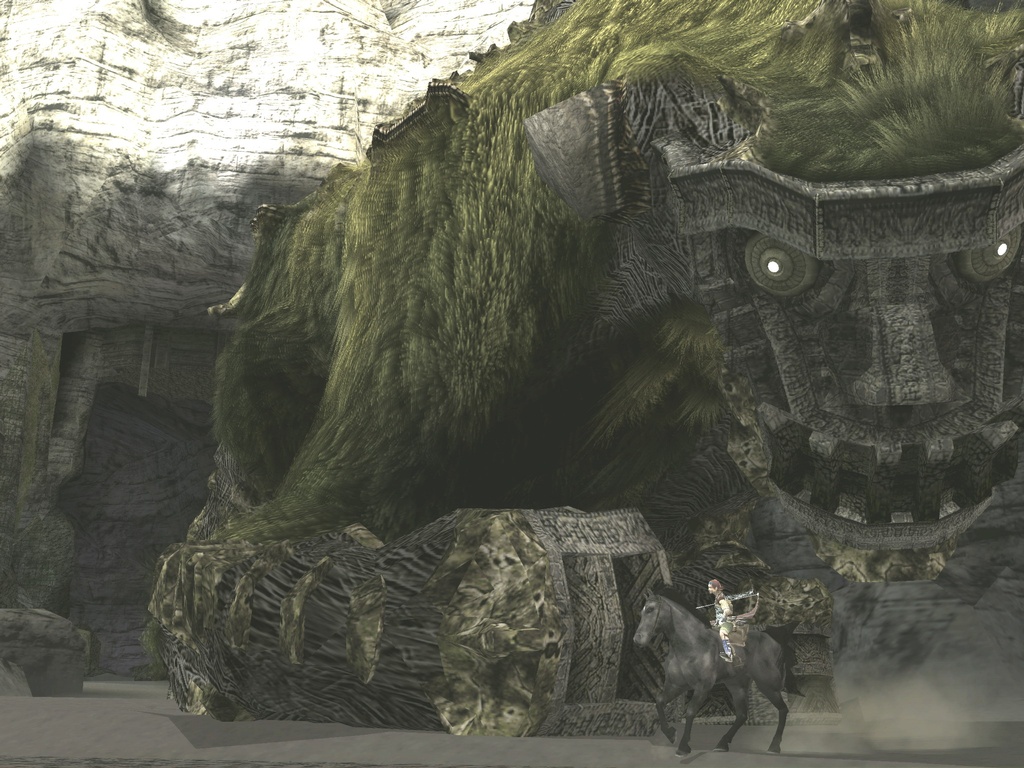
I have to admit that I didn't play too much of either Ico or Shadow of the Colossus when they were released in 2001 and 2005, respectively. I can't quite say why, but I was playing fewer video games at the time and probably busy with things like college, Nietzsche and drinking. I did, however, read about them. Since their releases, the legends have grown about these two games and I've been itching to get my teeth into them ever since. In September, after a 5-month delay, Sony will be releasing an HD collection with both games in an effort to tide over fans until the release of Team Ico's next game, The Last Guardian.
The games each have a plot, but it is not the focus. Ico was meant to be a typical "boy meets girl" story, and in many ways, it is. Ico is a boy born with horns who becomes outcast from his small village (much like Oblio in The Point). He is locked away inside a castle where he attempts to free Yorda, a young girl in danger from an evil queen. Shadow takes the opposite tract, moving from imprisoned romance to wandering solitude. Translated literally from the Japanese as "Wanderer and the Colossus," the game follows a young man who must wander the world killing large "colossi" to save the life of the woman he loves. These games, however, are not about story.
Lead designer Fumito Ueda and Team Ico explicitly aimed for a minimalist, lonely and whistful atmosphere for their games, ones that leave story to the side and focus on emotion. The upcoming Last Guardian, which centers around the relationship between a mountain boy and a gigantic dog/bird hybrid,seems to continue this trend.Fans of Ueda's games describe them as dreamy and engrossing, and I can say that, even from an outsider's perspective, I can feel the spell. While I've read some fantastic peices on these games, I don't want to get too much into the mindset of interpreting them before I've even begun. I'm looking forward mostly to the feeling. The more I look at screenshots and videos, the more I feel the desire to spend a month or so in some dusty tundra in an unnamed foreign land, cooped up in small shack with a howling wind and only these games to keep me company. They seem to demand to be played with minimal distraction. I'll leave you with these images. I feel they are more fitting for a group of games that seem more to want to leave an impression, a felt sense, than to entertain or excite the intellect.
As a bonus, check out the Japanese box art for the re-releases of Ico and Shadowvia VG247.com. Very cool. The Ico and Shadow of the Collosus Collection will be out in the United States on Playstation 3 September 27th. The Last Guardian is TBA 2012.