Certainly, collecting coins and points isn’t anything new in video games, and such practices are not limited to casual games. Achievements and trophies for console games seem to serve much the same purpose: providing a psychological sense of reward for playing, imbuing the player with the feeling that they are doing something useful, as if the games themselves were unworthy of our time. The accumulation of coins and achievements (or even the photographs in a game like Pokemon Snap) appears to function something like Susan Sontag’s notion of the tourist with a camera: he desperately desires to possess the world, to bring something back to his colleagues, to show to himself that “my time in leisure has not been wasted.”That site is now the home for some of my video game writing, though I'll still be updating this page with stuff on books, education, movies, and other art, most imminently with a post on Waiting for Superman. Do hold breath.
Showing posts with label Video Games. Show all posts
Tuesday, April 17, 2012
The Anxious Productivity of 'Temple Run'
My post on Temple Run and the productive logic of video games is now up on Popmatters. I chopped a section from it to include here below.
Labels:
iPhone,
Temple Run,
Video Games
Tuesday, March 20, 2012
Housekeeping, Conferences and the Significance of Journey
Howdy everyone,
Sorry for the long stretch with no posts. I've been working on a paper on Argentina- the one I posted about way way back in July- to present at a few conferences. The paper still isn't done, but I presented it once already and am headed off to do another presentation this weekend. In the mean time, I have a post on PopMatters about my favorite game of recent memory, Journey. Here's a clip below:
For some time, critics, myself included, have struggled to find ways to interpret games through artistic parameters that we are familiar with, to apply our understanding of what is meaningful in other art forms to a new and developing medium. Video games do not, at least not yet, do what literature or movies do. On the surface, they have little to offer in terms of cultural criticism and their stories are for the most part god awful. The heralding of Heavy Rain, with all of its absurd melodrama and B-movie plot twists, as a hallmark of storytelling should tell us all that we need to know about the current state of the medium in this respect. And yet, those of us who play video games know (and know with a passion) that there is something significant here, something more to playing a game than just… well, playing a game.Enjoy! I'm off to sunny Boston, MA!
Labels:
academics,
conferences,
Journey,
Video Games
Thursday, October 13, 2011
I Don't Know What Video Games Are
A few weeks ago I wrote about how the most common media to compare video games to was film. At the time it seemed a bit strange to me that the easiest comparison was films and not other types of games, as one might expect given the title "video games." That games don't readily come to mind when talking about video games, to me refects a confusion about what the medium actually is. personally, architecture always seemed a fitting comparison. I can imagine looking with awe at a work of beautiful architecture from a distance. I can also image exploring it, walking through it, interacting with it, as I would with something like Mario 64. And as I think more and more about the question of what games are, I’m inclined to the position that most video games are not in fact games, but a new type of media entirely that contains aspects of games within it.
What do we know about video games though? We know what they are not. We know video games are not films...or books or plays for that matter. And for a moment, I’d like to assume they aren’t games either. So what are they? In the article linked above, Most computer games aren't games at all... Mike Jones examines the nature of games, comparing various definitions of "game" to four popular video games (Tetris, Bioshock, WoW and The Sims), ultimately concluding that, of the four, only Tetris truly constitutes a game. In looking for the proper term, Jones suggests a fragmenting of our concept of video games, implying that there is no one category for all of them to fit under. In doing so, he suggests the terms puzzle, simulation, interactive story and virtual world, before eventually using the term “screen-based media entertainment and art,” a few times to refer to our broader cultural category for video games. This term seems overly broad though, applying to television shows, films, the Wii news feed, and any number of the diverse forms of entertainment that now inhabit our screens. It also applies to many games in the strict sense of the word like Solitaire or Snake. But I don’t think Jones sees it as a true definition either.
Like Jones, I don’t endeavor to provide a successful definition of video games in this post. As Rick Altman writes in Silent Film Sound, "New technologies are always born nameless. Assimilated to multiple possible models, new technologies always begin life with multiple monikers rather than a single stable name." Maybe, as video games become widely accepted enough to demand more attention and increased variety, we will get to the point where multiple names become more appropriate than a singular name. And so I’m not going to try to re-name “video games,” but only to add some thoughts to help better understand what they are. I believe the concept of “crisis historiography” will be helpful here. First developed by Altman in a work that focuses mainly on the development of the cinema in relation to a host of other mediums- radio, vaudeville, photography, theater and others, crisis historiography provides a helpful twentieth century paralell to our twenty-first century dilemma.
Altman uses cinema as his main example, but broadens his scope to highlight the ways that we conceptualize and define all new technologies and the resultant art that comes out of them. He argues that all representational technologies are socially and historically contingent. Moreover, they are defined specifically in relation to previously dominant modes of representation. For our purposes in looking at video games, literature, film, theatre and painting are the culprits. He writes,
Successful representation has always depended on the ability of new media to disguise themselves as old media, to meet the requirements established in existing media. Because new representational modes are perceived and appraised according to in-depth training received in the school of previous modes, proper understanding of representational technologies must always start with analysis of one medium’s attempt to do the job of another. (17)In highlighting the ways in which we, perhaps by necessity, use standards established by previous media to explore the newer mediums, Altman defines nearly to a tee our current discussions about games. Consider the following quotes from Roger Ebert, G. Christopher Williams and myself:
– Ebert, “Video Games Can Never Be Art”
No one in or out of the field has ever been able to cite a game worthy of comparison with the great poets, filmmakers, novelists and poets.
We appreciate the design of the narrative circumstances in Hamlet because we are not involved in any way in the action…It’s a bit more difficult to make such an argument about the player’s experience in Catherine…
– G. Christopher Williams, "Why Video Games Might Never Be Art"
When my game experience felt so much like my literary one, and not at all like my experience with the film, it brought to mind the overlaps between games, films and movies.In each quote, we see the inability to escape from notions about how art and artistic mediums do and should function...notions that are based on our experience with previous forms. There are established standards that develop in large part from the previous media available to us and from the previous thinking about art through these media. And by assimilating our new experiences with newer media to our old standards from old media, we are able to make sense of what is undefined and novel. But are we accurate? And if we are not accurate, what elements of meaning, representation, truth, exploration and understanding do we miss out on by applying standards for what constitutes good theater or literature to a video game or internet video?
–Myself, "Final Fantasty VI For the First Time: Why (Some) Video Games Might Be More Like Novels Than Films"
Given the blossoming nature of the medium in discussion, it seems like a safe bet to say that we don’t totally understand video games. Bur do we even understand the old standards and values that we use to evaluate art? If, like Altman argues, our understanding of media and art is socially constructed, then how can the theories and artistic standards that surround these artistic texts not be socially and historically contingent as well? Writing about the changing attitudes towards Shakespeare in America over several centuries, Scott Juster touches on this issue in an eloquent peice arguing that definitions of art are inherently mutable:
Herein lies the most insidious aspect of our historically-relative cultural hierarchy: we are compelled to position specific games and the entire medium along some theoretical, fallacious grand chain of artistic merit. The chain is powerful and restrictive. It brings order to a chaotic world by telling us what pieces of art are higher than others. The chain feels like it has existed forever and is immutable, but we know that this is not true. As is demonstrated by Shakespeare’s history in America, the boundary between mass entertainment and high art is composed of little more than social beliefs.In our discussions of the validity of video games, we use definitions and terms as if they are settled and absolute, occasionally paying lip service to their ultimate subjectivity without really believing those disclaimers. However, the limitations of our own experience prevent us from knowing either the nature of art or of video games themselves. From Plato to Nietzsche to Barthes, there are innumerable theorists to back up whatever position we want to take about art as we attempt to define constructed and abstract concepts in ways that suit us. But the question is never settled. Both the mediums and the standards are in constant flux. And it seems at this point, we don't even have settled terms to discuss either.
Image via Girl Gamer UK
Labels:
art,
crisis historiography,
Rick Altman,
Video Games
Tuesday, September 20, 2011
Final Fantasty VI For the First Time: Why (Some) Video Games Might Be More Like Novels Than Films
In the age of 3D graphics and professional voice actors, it goes without saying that the most common medium to compare video games to is film. There are probably two main reasons for this. First, on an experiential level, movies provide the easiest comparison: both are visual and auditory mediums that are commonly played/watched on a television and often follow a story through a narrative arc from beginning to end. Games such as Red Dead Redemption and Uncharted invite the comparison further by styling their aesthetics after action films. The other reason, I believe, has to do with the history of film as an artistic medium. Film started as a medium that had almost immediate mass appeal, yet still had to fight for its place in the artistic world. In the early part of the twentieth century, film theorists and filmmakers wailed about the possibilities of their new medium, elbowing and shoving their way to artistic legitimacy as politicians and moral watchdogs condemned the cinema as licentious and wild. For those of us looking at video games today, the parallels are wide and many. And, so, oftentimes we think of playing a game, especially a cinematic one like Final Fantasy VII or the increasingly filmic Rockstar games, as akin to watching a movie…a really long movie. However, as games get longer, and ironically, more cinematic, the experience of playing a game can have just as much similarity to reading a novel as to watching a film.
And this brings me to Final Fantasy VI (originally released as Final Fantasy III in the US for SNES). Over the last few weeks, I’ve been playing through this heralded classic for the first time. With a huge overworld and quest that supposedly lasts upwards of fifty hours, there’s a lot of game here. And it’s been consuming my time like almost no other activity (except for The Wire. Good lord what a show!). I get home from work, I play FFVI. I wake up on Saturday. I play FF VI. I eat mac ‘n’ cheese. I play FF VI. You get the idea. And what is so great about this game, you might ask. FFVI is unique in the sense that, while it is a sprite-based game in some ways limited by its format, its plot was A) fairly complex, both in its structure as well as its themes, and B) involved a lot of character development. Compared to traditional save the princess tales of sorcery, it had a literary quality. I wouldn’t call it Proust or Austen, but it certainly had some substance to it.
In FFVI, much of the gameplay not devoted to the plot is spent wandering around towns, exploring deserts or crevices in mountains and talking to the quaint characters that you meet along the way. I love how, in traditional JRPGs, when you walk into a town and talk to someone, the character has some totally random fact to tell you. It gives the small sprite characters not only a personality, but an endearing sense of innocence and humor. There’s something about the way the dialogue works, without standard introductions or other markers of conversation. You press A and whalla, “A strange rabbit has been eating all my crops.” Oh, good to know. Everywhere you go in the game, there’s some new side quest or non-essential person to speak to. They’re not required, but they add a lot of depth and charm. And they give you a chance to sink into the world, to really get to know the space and place in which your game experience is taking place.
In thinking about my experience with the game, the complex, lengthy plot melds together with the ability to wander and explore to form a holistically immersive experience. As I’ve played, I’ve been trying to pinpoint exactly how to describe and how to think about that experience. The closest parallel for me was the last novel I read, Cormac McCarthy’s No Country For Old Men. This may seem like a strange comparison at first: steampunk fantasy world and gritty, nihilistic Texas thriller. The link between them was in the way that, while experiencing either game or novel, you get a chance to live in the world they’re set, to really spend time with the characters. Of course this can be said of many novels, but this one stuck out not only because I had just finished it, but because its film adaptation is such a fantastic and faithful one. When my game experience felt so much like my literary one, and not at all like my experience with the film, it brought to mind the overlaps between games, films and movies. The Coen brothers’ film based on No Country was great, but it had more of an immediate, aesthetic impact. In the novel, which is strikingly similar, you get more time to really know who you’re dealing with, to feel the landscape and enter into another world. To me, this type of experience is the core of the appeal for so many adventure games.
And so I wonder if playing Final Fantasy VI, or other long story-based games, is not in fact more akin to reading a novel than watching a film. It’s hard to really draw your own mind into a film in only a few hours. Novels and games take weeks, months, sometimes even years. The time between playing is spent thinking about the media object in the question. Sessions last hours at a time and you leave them feeling like you’ve just woken up into some other universe. You live for days on end with characters, learning about them slowly and through smaller, more drawn out interactions. In terms of what matters, the experience of the art and what you can take from it, perhaps our metric of film comparison is not only lacking in its relation to interactivity, but also to its accuracy as a comparison for more weighty games. Of course there are a whole host of issues outside of this one, but right now, I’m thinking, all other complications aside, the experience of playing games just might be more like the experience of reading novels than watching films.
Top image via DesktopMadness
Saturday, September 10, 2011
Reader Response Theory and Video Games: Thoughts on G. Christopher Williams's "Why Video Games Might Not Be Art"
I’m a little late to the game on this one (no pun intended), but I’d like to offer a few thoughts on Christopher Williams’s piece for PopMatters, "Why Video Games Might Not Be Art." Giving his article a read before this one will probably elucidate many points here and is also worth reading for its own merits. The main thrust of my thinking in this post begins with something Dr Williams says early on, commenting on a quote from Roger Ebert’s famed “Video Games Can Never Be Art” article:
The really crucial observation to me exists in that last sentence, in which Ebert is suggesting that the player is doing something in playing a game, whereas normally an audience’s relationship to art (be that a painting, novel, film, etc.) is merely “experiencing” (in some passive sense of the word) the object before them, allowing meaning to “wash over them”, rather than actively participating with the artwork.
My problem is not with Williams's assessment of video games (even though I take issue with this aspect of Ebert’s original article) but in his later assessment of where value arises in other art forms. Williams discusses the history of aesthetics, citing Aristotle and Eliot in his discussion and gives some credence to the notion of personal interactivity in the field of rhetoric, but mainly examines Art with a capital A through the assumption that it is something you watch from the outside, not experience as a participant. In discussing Joyce, Willams does discuss the ways in which a person brings something to a text, but he only allows for true meaning to arise when the participant has stepped away from the art work, after the interaction is completed. I would like to discuss this focus on looking at a text from the outside in opposition to a view that sees meaning as arising from an interaction with a text. The reader-response theorists of the twentieth century probably provide the most helpful analysis in this area.
Reader-response theorists, incudling Wolfgang Iser, Stanley Fish, Louise Rosenblatt, Roland Barthes and others, have argued that the act of “reading,” both literally and broadly speaking, is an interactive process. Perhaps more importantly, the act of making meaning occurs not after, but through a "transaction" or interaction between the reader and the text. In Literature as Exploration (1938), Louise Rosenblatt takes perhaps the first stab at this type of thought:
The special meaning, and more particularly, the submerged associations that these words and images have for the individual reader will largely determine what the work communicates to him. The reader brings to the work personality traits, memories of past events, present needs and preoccupations, a particular mood of the moment, and a particular physical condition. These and many other elements in a never-to-be-duplicated combination determine his response to the peculiar contribution of the text (30-31).To Rosenblatt, meaning arises, not when one looks at the text from the outside, appreciating from an intellectual and emotional distance its various impressive and brilliant efforts, but through an intellectual and emotional connection made through an understanding of its elements as they connect to your own life. This doesn't mean that a book needs to be about someone like you or relate to your life in some concrete and literal fashion, only that the ideas, emotions, characters and words need to resonate and relate on some level. I don't need to live in 19th century Russia to appreciate Notes from Underground, but I do need to have some idea of what existential angst is like, what it feels like to be an outsider, and how "rational society" can create a sort of insanity. Or, I could read the book on any number of levels, with any number of interpretations, and the meaning that would arise would depend on which aspects of the book resonated with my experiences. Here, I am not taking up the banner of extreme subjectivity. I can't decide that Notes from Underground is about loving puppies or the war in Iraq. However, I will not understand it and I will not take meaning from it except on the level that I can connect it to something outside of itself. And so I must interact with the text.
It may help to discuss this sort of meaning-making in relation to a video game. When I was playing through “Flower” on PS3 a few years ago, I was initially floored by the dreamy, transcendent quality of it. Here I was in New York City, in front of a TV in my 8th floor walk-up, drifting off into some green wonderland where, as far as I could figure at first, my only goal was to make flower petals fly around and spin them into dizzying wondrous patterns. As the game progressed, I started to see that the ways in which my experience of flying around and making flowers bloom was altered as the landscape became darker and gloomier.
However, this experience alone, interactive as it was, was not enough to see a particular meaning in the game as meaning is traditionally understood in art and literature circles. I had to go beyond the game and beyond my direct physical interaction with it to make sense of my experience. I needed to interact mentally with the game as I played, to think about what I was doing on something other than a tactical level, as I would with any other artistic text. And as I played, I thought about pollution and the destruction of the environment, the disappearing green space in urban communities and the inattention that all of this receives from our political leaders. And most importantly, I thought about how this was mostly understood as an abstract concept. Environmental change occurs so slowly that it is difficult to understand experientially. We need Al Gore and millions of scientists in order to make sense of our gloomy prospects. And I thought about how this game gave an experiential way to understand the destruction of the environment by allowing me to play in a wonderland only to watch it degrade before my eyes. Without both my physical interaction with the game as game and my mental interaction with the game as text, I would not have been able to derive the same meaning. And the same type of mental interaction that I had with this game occurrs with a book, a film, or a painting. As you read or watch, you think about what you're experiencing and you combine it and connect it with your own thoughts on the world and you make an interpretation.
This account is an almost disrespectfully simplified example to illustrate reader-response theory and one that ignores many other strands of the field. As well, I don’t mean to imply that my process for making meaning was as conscious and direct as it may seem. Understanding texts is not an easy and simple process, it occurs through various interactions, through literal and metaphorical re-readings and re-examinations. Just as you can "get it" as you do a re-reading of a book, experiencing the story anew and seeing new aspects, the act of playing a game can facilitate the process of understanding and making meaning.
In arguing for an interactive theory of meaning-making, I also don't intend to propose that reader-response theorists should be taken as gospel and swallowed whole-heartedly. However, a crucial component in most discussions of video games as art is the fact that previous aesthetic theory and previous thinking on art in general has ignored or shunned interactivity. And so, where do we turn to examine this new medium? The reader-response theory provides an examination of a crucial aspect of video games, interactivity, but does so with a more time-tested medium, literature.
I think meaning is possible in video games, or maybe more accurately, meaning is possible through electronic media commonly referred to as video games. Perhaps it just exists in ways that are not obvious when you look through critical lenses designed for different formats. And perhaps the interactivity that seems so strange and bewildering to us as we try to understand exactly what this medium is and does has been with us all along.
Labels:
Aesthetics,
reader-response theory,
Video Games
Thursday, July 14, 2011
Vile Bodies and Bad Bitches in Brooklyn
If you're in New York City on Friday night, you might be interested in checking out what's going on at 285 Kent Avenue in Williamsburg. It's the party with the coolest mix of arcade games and alternative, punk, dance, etc. music in the city. Vile Bodies, as the show is called, includes a lineup of indie garage rock bands and DJs. There's also a lineup of sexually-themed videogames called Bad Bitches from Babycastles, curated by Leigh Alexander. I'll be there, but don't take it from me. You can read about it on MyOpenBar, Kotaku, Motherboard and Facebook. $10. 1/2 price before 7pm. Open vodka bar.
Labels:
Music,
New York City,
Party,
Video Games
Thursday, July 7, 2011
Has The Zelda Series Become Stagnant?
Disclaimer: This article ignores all portable Zelda games, as I have never put much time into them.
![]()
I have a professor who is hopelessly addicted to superhero movies, anticipating translations of comic book vigilantes to on-screen juggernauts with glee and obsession. He reads previews. He watches trailers. He counts the days on his calendar. He buys tickets for opening night.
“I’ve got my popcorn" he says, "I’ve got the big soda, I’m all ready. I’m thinking, ‘Okay, Daredevil sucked, but man, Green Lantern is gonna be great’…and then it always sucks. But you know what, they always get me the next time. I think, ‘man, this next one will be the one that does it. I just know this one is gonna be awesome.'"
This is how I’ve felt about the Zelda franchise for the past ten years and this is what scares me as I look toward Skyward Sword, the latest installment in Nintendo’s fabled franchise. I can't wait for it, but I can't help but feel like it's going to be disappointing.
Now, before the tomatoes and beer bottles start flying, let me say, I don’t think the Zelda games suck. Far from it. The series has always been fantastically produced and unquestionably one of the best in the history of gaming. But the recent entries, while well-constructed and clearly crafted with a lot of care, seem to lack something. Some intangible magic. After each one, I am left feeling like the game was merely good, not wondrous, not other-worldly, not, if you’ll excuse the extreme arrogance in assuming my own opinion applies ubiquitously to a company enjoyed by millions, what is great about Nintendo.
What is it exactly? What is missing? To be honest, I don’t know, but I do have a few inklings. It’s my hope that in this post I can explore the question, and that maybe some readers (there must be at least a few of you) can chime in with their thoughts as well (Please no flaming, I ♥ Nintendo too!).
Hypothesis 1: It’s Just Me: I’m Old and the Magic is Gone From My Life. I Should Just Don the Suit, Have Kids, Drop the Controller and Die.
![]()
My first thought is that perhaps the sensation that I'm looking for in Zelda games is more a symptom of youth than of the games themselves. I can’t help but wonder what experience a twelve-year old gets from playing Twilight Princess or Wind Waker today. These games provide the same type of gameplay as Ocarina did, the same dungeon-crawling, town-wandering, forest-exploring and boss-fighting that made the series so famous. Perhaps nothing has changed and I’m just at a point in my life where the type of belief required to make these game worlds come alive is just not in me. Should I expect it to be? Of course the old woman who spoke one sentence and lived on the outskirts of the town in Zelda II seemed mysterious when I was seven, but what would I think now? But here's the thing: that old woman still seems mysterious. At this juncture, it’s hard to separate nostalgia from the genuine feeling of wonderment. I don’t remember playing the game, so I’m not pining for some specific sense of family or youth, yet hearing the music from an old game or seeing images like the one to the left, the feeling is there. The question seems to be, was there something particularly wondrous in the old NES and Super-NES games or is it just nostalgia?
Hypothesis 2: Zelda Was New, Now It’s Old
What gives me pause on the whole nostalgia explanation is the progression of Zelda games. From the original up until Ocarina of Time, nearly every game was a new experience. The first essentially invented a genre in itself. The sequel was a sidescroller mash-up that, even though it wasn’t the best game in the world, had its own charm and diverged greatly from the original. Link to the Past provided perhaps the most fully-articulated, living game world in a console game up until that point, and Ocarina created the same type of new experience in 3D, showing all games after it How To Get Shit Done.
The entries since then, try as they might to introduce new elements (and you have to respect them for trying), have still felt like variations on the experience established in Ocarina. Masks, cell-shading, realism. It was all cool. It was all enjoyable. But none of it felt new and none of it felt like magic, at least not to me. Frankly, Twilight Princess was boring for long stretches. And like I said before, it could just be me. I’m working with a very intangible concept here and it's hard to make clear lines in the sand. Still, I’ve been able to muster the same type of emotion for other games- Fallout, Okami, Flower. These games, however, are all intended for a slightly older, more mature audience. But they also all include some element that feels new, novel, strange. Maybe it’s just that a game, without feeling new in some way, has a hard time creating the sense of wonder that I’m pining for so much. And for a video game franchise, Zelda is more or less as old as stone on Death Mountain.
I also can’t help but wonder how much of this has to do with Miyamoto’s involvement. I’ve been reading about Miyamoto’s games and philosophy since I was in elementary school, and in all that time, it’s become clear that Nintendo’s innovative, experience-driven philosophy stems from him. He has been the heart and soul of the company for the last twenty-five years. And as the years have passed, he has been required to oversee more projects and has subsequently become less involved in the Zelda series. Maybe the reason that the later Zeldas feel like great games that lack that Miyamoto magic is because, well…they lack that Miyamoto magic. And maybe there's a new type of magic that I'm missing.
Nintendo: Stagnant and Innovative?
The question of Miyamoto’s involvement brings me to the question of Nintendo at large. You certainly can’t accuse them of not trying new things, and I believe, exciting new things. The first introduction of the Wii reinvigorated in me a spirit of newness and novelty that felt lost during the previous console generation. But, Nintendo’s attention and, more importantly, its inspiration, has seemed focused on other areas. The traditional, exploratory, world-creating games have fallen to the wayside in all the hullabaloo (what a fantastic word!) of fitness, fencing and party madness.
Of course, Metroid Prime and Mario Galaxy were great, with the original Prime being probably my favorite game of the last two generations combined, but what we’ve mainly seen from Nintendo the last few years is a privileging of other experiences, ones that shoot for communal fun and only fun. I love Wii Bowling as much as the next guy (literally the next guy- the guy right next to me having a blast playing it too), but it's a different beast from the Nintendo that captured everyone's heart in the 15 years between 1985 and 2000. And yes, I realize that their new console is supposedly more targeted at "hardcore" gamers, but here it seems more like they're going for the Halo market than the Costume Quest one.
So, what does this have to do with Miyamoto? Well, it seems like Nintendo tends to follow the sparks of his inspiration. Even though there are many wonderfully talented and creative people there, he seems to be the head honcho in terms of new thinking. In terms of Mario and Zelda, they were created in the eighties based on experiences he had playing as a child. Now nearly sixty, how can Miyamoto be expected to be inspired by the same types of thoughts and experiences now as he was way back when?
I’ll always respect Nintendo for their insistence on going against the tide, on going it alone with at least some semblance of philosophical conviction. No matter how corporate and annoying many of their practices may be, in comparison to most mega-companies, they ooze originality. As Michael Abbot of Brainy Gamer put it in a post about Wii U, “Nintendo will bet the farm on another big idea. That's what they do, and it's why I always root for them a little more than the others.” However, I can’t help but feel that maybe Nintendo’s consoles are no longer the place for the types of experiences that I’m most excited about: ones that are other-worldy, exploratory, mysterious and, dare I say, magical.
With all that said, I'm still psyched about Skyward Sword. I just know this one is gonna be awesome.
I have a professor who is hopelessly addicted to superhero movies, anticipating translations of comic book vigilantes to on-screen juggernauts with glee and obsession. He reads previews. He watches trailers. He counts the days on his calendar. He buys tickets for opening night.
“I’ve got my popcorn" he says, "I’ve got the big soda, I’m all ready. I’m thinking, ‘Okay, Daredevil sucked, but man, Green Lantern is gonna be great’…and then it always sucks. But you know what, they always get me the next time. I think, ‘man, this next one will be the one that does it. I just know this one is gonna be awesome.'"
This is how I’ve felt about the Zelda franchise for the past ten years and this is what scares me as I look toward Skyward Sword, the latest installment in Nintendo’s fabled franchise. I can't wait for it, but I can't help but feel like it's going to be disappointing.
Now, before the tomatoes and beer bottles start flying, let me say, I don’t think the Zelda games suck. Far from it. The series has always been fantastically produced and unquestionably one of the best in the history of gaming. But the recent entries, while well-constructed and clearly crafted with a lot of care, seem to lack something. Some intangible magic. After each one, I am left feeling like the game was merely good, not wondrous, not other-worldly, not, if you’ll excuse the extreme arrogance in assuming my own opinion applies ubiquitously to a company enjoyed by millions, what is great about Nintendo.
What is it exactly? What is missing? To be honest, I don’t know, but I do have a few inklings. It’s my hope that in this post I can explore the question, and that maybe some readers (there must be at least a few of you) can chime in with their thoughts as well (Please no flaming, I ♥ Nintendo too!).
Hypothesis 1: It’s Just Me: I’m Old and the Magic is Gone From My Life. I Should Just Don the Suit, Have Kids, Drop the Controller and Die.
My first thought is that perhaps the sensation that I'm looking for in Zelda games is more a symptom of youth than of the games themselves. I can’t help but wonder what experience a twelve-year old gets from playing Twilight Princess or Wind Waker today. These games provide the same type of gameplay as Ocarina did, the same dungeon-crawling, town-wandering, forest-exploring and boss-fighting that made the series so famous. Perhaps nothing has changed and I’m just at a point in my life where the type of belief required to make these game worlds come alive is just not in me. Should I expect it to be? Of course the old woman who spoke one sentence and lived on the outskirts of the town in Zelda II seemed mysterious when I was seven, but what would I think now? But here's the thing: that old woman still seems mysterious. At this juncture, it’s hard to separate nostalgia from the genuine feeling of wonderment. I don’t remember playing the game, so I’m not pining for some specific sense of family or youth, yet hearing the music from an old game or seeing images like the one to the left, the feeling is there. The question seems to be, was there something particularly wondrous in the old NES and Super-NES games or is it just nostalgia?
Hypothesis 2: Zelda Was New, Now It’s Old
What gives me pause on the whole nostalgia explanation is the progression of Zelda games. From the original up until Ocarina of Time, nearly every game was a new experience. The first essentially invented a genre in itself. The sequel was a sidescroller mash-up that, even though it wasn’t the best game in the world, had its own charm and diverged greatly from the original. Link to the Past provided perhaps the most fully-articulated, living game world in a console game up until that point, and Ocarina created the same type of new experience in 3D, showing all games after it How To Get Shit Done.
The entries since then, try as they might to introduce new elements (and you have to respect them for trying), have still felt like variations on the experience established in Ocarina. Masks, cell-shading, realism. It was all cool. It was all enjoyable. But none of it felt new and none of it felt like magic, at least not to me. Frankly, Twilight Princess was boring for long stretches. And like I said before, it could just be me. I’m working with a very intangible concept here and it's hard to make clear lines in the sand. Still, I’ve been able to muster the same type of emotion for other games- Fallout, Okami, Flower. These games, however, are all intended for a slightly older, more mature audience. But they also all include some element that feels new, novel, strange. Maybe it’s just that a game, without feeling new in some way, has a hard time creating the sense of wonder that I’m pining for so much. And for a video game franchise, Zelda is more or less as old as stone on Death Mountain.
I also can’t help but wonder how much of this has to do with Miyamoto’s involvement. I’ve been reading about Miyamoto’s games and philosophy since I was in elementary school, and in all that time, it’s become clear that Nintendo’s innovative, experience-driven philosophy stems from him. He has been the heart and soul of the company for the last twenty-five years. And as the years have passed, he has been required to oversee more projects and has subsequently become less involved in the Zelda series. Maybe the reason that the later Zeldas feel like great games that lack that Miyamoto magic is because, well…they lack that Miyamoto magic. And maybe there's a new type of magic that I'm missing.
Nintendo: Stagnant and Innovative?
The question of Miyamoto’s involvement brings me to the question of Nintendo at large. You certainly can’t accuse them of not trying new things, and I believe, exciting new things. The first introduction of the Wii reinvigorated in me a spirit of newness and novelty that felt lost during the previous console generation. But, Nintendo’s attention and, more importantly, its inspiration, has seemed focused on other areas. The traditional, exploratory, world-creating games have fallen to the wayside in all the hullabaloo (what a fantastic word!) of fitness, fencing and party madness.
Of course, Metroid Prime and Mario Galaxy were great, with the original Prime being probably my favorite game of the last two generations combined, but what we’ve mainly seen from Nintendo the last few years is a privileging of other experiences, ones that shoot for communal fun and only fun. I love Wii Bowling as much as the next guy (literally the next guy- the guy right next to me having a blast playing it too), but it's a different beast from the Nintendo that captured everyone's heart in the 15 years between 1985 and 2000. And yes, I realize that their new console is supposedly more targeted at "hardcore" gamers, but here it seems more like they're going for the Halo market than the Costume Quest one.
So, what does this have to do with Miyamoto? Well, it seems like Nintendo tends to follow the sparks of his inspiration. Even though there are many wonderfully talented and creative people there, he seems to be the head honcho in terms of new thinking. In terms of Mario and Zelda, they were created in the eighties based on experiences he had playing as a child. Now nearly sixty, how can Miyamoto be expected to be inspired by the same types of thoughts and experiences now as he was way back when?
I’ll always respect Nintendo for their insistence on going against the tide, on going it alone with at least some semblance of philosophical conviction. No matter how corporate and annoying many of their practices may be, in comparison to most mega-companies, they ooze originality. As Michael Abbot of Brainy Gamer put it in a post about Wii U, “Nintendo will bet the farm on another big idea. That's what they do, and it's why I always root for them a little more than the others.” However, I can’t help but feel that maybe Nintendo’s consoles are no longer the place for the types of experiences that I’m most excited about: ones that are other-worldy, exploratory, mysterious and, dare I say, magical.
With all that said, I'm still psyched about Skyward Sword. I just know this one is gonna be awesome.
Labels:
exploration,
Mario,
Miyamoto,
Nintendo,
Video Games,
Zelda
Friday, July 1, 2011
E3 2011: The Top Five PS3 Games for Artistically-Inclined Gamers to Anticipate: Part 5: Journey
Interpretation takes the sensory experience of the work of art for granted, and proceeds from there. This cannot be taken for granted, now. Think of the sheer multiplication of works of art available to every one of us, superadded to the conflicting tastes and odors and sights of the urban environment that bombard our senses. Ours is a culture based on excess, on overproduction; the result is a steady loss of sharpness in our sensory experience. All the conditions of modern life - its material plenitude, its sheer crowdedness - conjoin to dull our sensory faculties. And it is in the light of the condition of our senses, our capacities (rather than those of another age), that the task of the critic must be assessed. What is important now is to recover our senses. We must learn to see more, to hear more, to feel more.
- Susan Sontag, Against Interpretation
If I can describe the experience with words, then why are we even making the game? People like to ask us, and we would like to tell you, “Oh, we would like to make a sense of awe.” But what kind of awe is that?
-Jenova Chen, thatgamecompany, from 4colorrebellion
- Susan Sontag, Against Interpretation
If I can describe the experience with words, then why are we even making the game? People like to ask us, and we would like to tell you, “Oh, we would like to make a sense of awe.” But what kind of awe is that?
-Jenova Chen, thatgamecompany, from 4colorrebellion
Labels:
Aesthetics,
E3,
Journey,
PS3,
Susan Sontag,
Video Games
E3 2011: The Top Five PS3 Games for Artistically-Inclined Gamers to Anticipate: Part 4: Bioshock Infinite
Over the last few years, the original Bioshock has become a classic, a staple in the collections of both blast-em-all-to-hell shooter fans and gamers who wish to see the medium as something greater than a form in which you can blast em all to hell. Bioshock was set in an underwater Atlantis-in-ruins called Rapture. As the tale goes, the city was founded by the uber-capitalist, Ayn Rand-following Andrew Ryan (get it Ayn Rand/Andrew Ryan) in an attempt to create a society without the limitations imposed by anything that hinted at equality or morality. The protaganist, Jack, stumbles upon Rapture after a watery plane crash to discover a city teeming with violence and drug addiction. That's where the action starts.
With a kill-or-save stab at morality and a philosophically-inclined backstory, Bioshock became a favorite of Ethics 101 students round the globe. Plus, it was pretty exhilirating and creeped the shit out of everyone. Bioshock 2, developed not by Irrational Games, but by 2K Marin, was heralded by the casual game press, but didn't acheive the same sort of cult status or receive the same type of recognition from intellectual, snobby types like myself. It was heavier on the action, adding a multiplayer mode and tighter gun fights, and lighter on the philosophizing.
Bioshock Infinite, not so much a sequel as a similar game with a similar relationship between aesthetic content and philsophical backstory, seems like a return to form. Irrational and its leader Ken Levine are back at the helm, and their new project delivers a completely new story in a completely new game world, albeit one with clear structural similarities to Rapture. Infinite takes place in the floating city of Columbia, a place whose aesthetics mesh carnivale culture of 1930s America with the sense of futuristic decline that pervaded Rapture. Gone are the original's muddy tones of underway decay, replaced by a blazing sunshine and colors bright enough to slap on a flag. Something seems amiss though, as the contrast between the game's showcase of natural beauty and man-made crumminess illustrates.
How cool is this concept art?
In Infinite's game world, capitalist nut-job has been replaced by socialist distopia. An extreme version of a 1960s-style grand society/commune, Columbia was established by the American government and then quickly abandoned after a scuffle between city officials and Chinese nationals. The player takes on the role of Booker Dewitt, an ex-Pinkerton detective in search of a mysterious woman named Elizabeth. I won't go any further, so as to avoid any spoiling of the story.
This game has all the elements in the right place. The story sounds pretty cool, the floating city looks great and I'm glad to see the franchise again taking on a complex, imaginative story with political and philosophical undertones. Still, I can't help but feel a little disappointed by the repetition of the setup from Bioshock 1. I can picture it now: "Okay, guys we did capitalism, let's do socialism next." While I applaud the effort to move away from Rapture after two games, I wonder if there wasn't a more nuanced direction to take the thematics. It's like a new Starburst flavor rather than a new fully-fledged artistic project. Still, when you see screenshots or videos from the thing, you'll be hard-pressed to bitch about the story, which isn't bad even if it does borrow elements from the original. It is a sequel after all.
Conclusion: with this new iteration it seems that Bioshock holds its place as the king of the blockbusters with intellectual tendencies, at least until Fallout 4 comes out (fingers crossed). Bioshock Infinite is set to be released on Xbox 360, Playstation 3, and PC sometime in 2012.
Labels:
Bioshock,
Bioshock Infinite,
E3,
PS3,
Video Games
Tuesday, June 21, 2011
E3 2011: The Top Five PS3 Games for Artistically-Inclined Gamers to Anticipate: Part 2&3: Team Ico Games
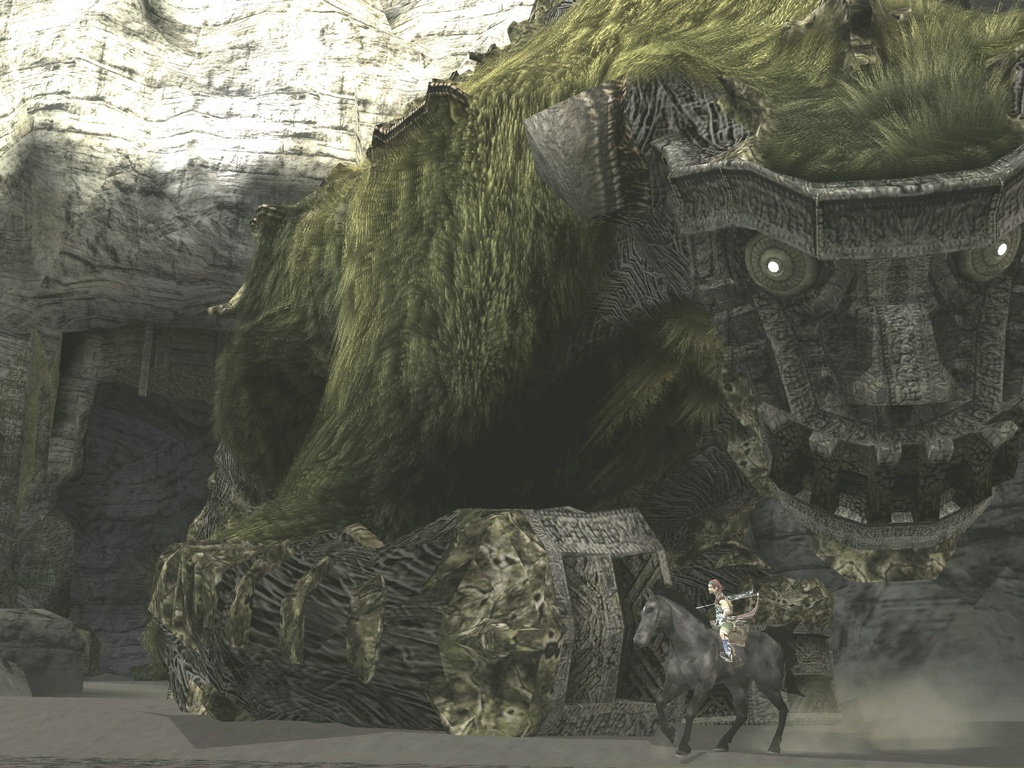
I have to admit that I didn't play too much of either Ico or Shadow of the Colossus when they were released in 2001 and 2005, respectively. I can't quite say why, but I was playing fewer video games at the time and probably busy with things like college, Nietzsche and drinking. I did, however, read about them. Since their releases, the legends have grown about these two games and I've been itching to get my teeth into them ever since. In September, after a 5-month delay, Sony will be releasing an HD collection with both games in an effort to tide over fans until the release of Team Ico's next game, The Last Guardian.
The games each have a plot, but it is not the focus. Ico was meant to be a typical "boy meets girl" story, and in many ways, it is. Ico is a boy born with horns who becomes outcast from his small village (much like Oblio in The Point). He is locked away inside a castle where he attempts to free Yorda, a young girl in danger from an evil queen. Shadow takes the opposite tract, moving from imprisoned romance to wandering solitude. Translated literally from the Japanese as "Wanderer and the Colossus," the game follows a young man who must wander the world killing large "colossi" to save the life of the woman he loves. These games, however, are not about story.
Lead designer Fumito Ueda and Team Ico explicitly aimed for a minimalist, lonely and whistful atmosphere for their games, ones that leave story to the side and focus on emotion. The upcoming Last Guardian, which centers around the relationship between a mountain boy and a gigantic dog/bird hybrid, seems to continue this trend. Fans of Ueda's games describe them as dreamy and engrossing, and I can say that, even from an outsider's perspective, I can feel the spell. While I've read some fantastic peices on these games, I don't want to get too much into the mindset of interpreting them before I've even begun. I'm looking forward mostly to the feeling. The more I look at screenshots and videos, the more I feel the desire to spend a month or so in some dusty tundra in an unnamed foreign land, cooped up in small shack with a howling wind and only these games to keep me company. They seem to demand to be played with minimal distraction. I'll leave you with these images. I feel they are more fitting for a group of games that seem more to want to leave an impression, a felt sense, than to entertain or excite the intellect.
As a bonus, check out the Japanese box art for the re-releases of Ico and Shadow via VG247.com. Very cool. The Ico and Shadow of the Collosus Collection will be out in the United States on Playstation 3 September 27th. The Last Guardian is TBA 2012.
The games each have a plot, but it is not the focus. Ico was meant to be a typical "boy meets girl" story, and in many ways, it is. Ico is a boy born with horns who becomes outcast from his small village (much like Oblio in The Point). He is locked away inside a castle where he attempts to free Yorda, a young girl in danger from an evil queen. Shadow takes the opposite tract, moving from imprisoned romance to wandering solitude. Translated literally from the Japanese as "Wanderer and the Colossus," the game follows a young man who must wander the world killing large "colossi" to save the life of the woman he loves. These games, however, are not about story.
Lead designer Fumito Ueda and Team Ico explicitly aimed for a minimalist, lonely and whistful atmosphere for their games, ones that leave story to the side and focus on emotion. The upcoming Last Guardian, which centers around the relationship between a mountain boy and a gigantic dog/bird hybrid, seems to continue this trend. Fans of Ueda's games describe them as dreamy and engrossing, and I can say that, even from an outsider's perspective, I can feel the spell. While I've read some fantastic peices on these games, I don't want to get too much into the mindset of interpreting them before I've even begun. I'm looking forward mostly to the feeling. The more I look at screenshots and videos, the more I feel the desire to spend a month or so in some dusty tundra in an unnamed foreign land, cooped up in small shack with a howling wind and only these games to keep me company. They seem to demand to be played with minimal distraction. I'll leave you with these images. I feel they are more fitting for a group of games that seem more to want to leave an impression, a felt sense, than to entertain or excite the intellect.
As a bonus, check out the Japanese box art for the re-releases of Ico and Shadow via VG247.com. Very cool. The Ico and Shadow of the Collosus Collection will be out in the United States on Playstation 3 September 27th. The Last Guardian is TBA 2012.
Labels:
E3,
Ico,
Shadow of the Colossus,
Video Games
Sunday, June 19, 2011
E3 2011: The Top Five PS3 Games for Artistically-Inclined Gamers to Anticipate: Part 1: Papo & Yo
E3 2011 has come and gone, and with it a whirlwind of information on upcoming video games and consumer electronics, all of it filtered through the corporate mouthpeices of game companies, with snippets from the nerds whose work keeps them talking. The main focus of E3 is on huge commercial productions like Call of Duty 37, Halo 16, 3D Playstations and novelty consoles from Nintendo. Along with these chest-thumping endeavors, though, is the feeling of the new, the novel, the changing, The Future. Even for ideas and promises that won't see fruition or that will clearly bomb, E3 has a largesse for optimism, freely imbuing anyone who follows it with an excitement for what is to come. It is with this mind to seeing how gaming is changing and how it can be changed that I begin this list. I wanted to highlight a few games, some big, most small, that I'm most looking forward to.
Papo & Yo
Papo & Yo
In Braid, Jonathan Blow sought to create a game whose mechanics directly related to and deepened its themes. The game garnered heavy praise and I personally enjoyed it thoroughly; it was also one of the few that my girlfriend got hooked on. However, serious critics gave Blow a good deal of flack, claiming that it failed to properly achieve its aim, that the connection was lacking between thematics and gameplay. I tend to agree with them. The poetic level introductions set up a decently mature storyline and we were told, both in-game and through promotion, that the gameplay mechanism of time manipulation was meant to serve as a philosophical correlary to the story. Press square. Reverse character motion. Induce reflective moment. When I actually played the game though, it felt like a very clever platformer/puzzler with a beautiful aesthetic that was enhanced by the story set-up. The reflective part never really came into the equation for me.
In hearing about Minority Media’s first full game, the upcoming PSN download Papo & Yo, I’m wondering if we have a new shot at Blow’s dream, a game that does emotional depth through its gameplay. I’m guessing it won’t turn the gaming world on its head, but the possibility is still exciting. Despite its shortcomings, Braid was still a fantastic game head and shoulders above most, and if Papo & Yo feels even half as fresh, it’ll be worth the price of admission.
The game’s title is a thinly vield Spanportuglish mishmash that translates as Father and Me, a reference to creator Vaner Caballero’s experiences growing up with an alcoholic father in Colombia. The metaphorical stand-ins for father and son are a boy named Quico and his pet monster, Monster. I’m already endeared. The game’s adventures occur in Quico’s imagination as he attempts to escape the harshness of life in an unnamed South American favela. Monster tags along to help out on the puzzles and challenges that arise in Quico’s mind quest. Monster, however, is not as sweet as he seems at first: he is rabidly addicted to eating frogs and will sometimes act so impulsively in his pursuit of more frogs that he screws up Quico’s pursuits. I’m not much for summary (and I’m summarizing from what I’ve read anyway), so I’ll leave the rest of the description to a quote from IGN:
In his mind Quico can adventure in a surreal world where he can move houses simply by pushing around cardboard boxes, or where he can tug magical ropes to make stairs raise out of the ground. It's semi-realistic looking in its presentation, but mixes in enough strange scenery and bizarre looking environments that playing it is akin to moving through a waking dream. It's striking.
Video games tend to be an insular, thematically slight medium in which much of the meaning that is explicit often refers back to other games themselves (I’m still looking at you Braid). Whoever observed that there are more books written about other books than any other topic would have something to say about the nostalgia binge of the last five years. In this light, it’s exciting to hear about an atmospheric, thematically ambitious game that not only takes on the typical, if excellent, triumverant of nostalgia, coming of age and fantasy, but does so with a clear consciousness of weighter issues, namely global poverty and the harm it wreaks on families. I’m not going to get into the possibility of game published on Playstation Network potentially implying methods of resistence to the neo-liberal order (a guy can dream can’t he), but I’m already seeing monstrous potential for this game to mix fantasy, personal emotion and political reality in stunning ways (pun intended). All it needs to do is be touching though, and I’ll love it just the same.
Labels:
Braid,
Papo and Yo,
PS3,
Video Games
Sunday, January 2, 2011
A Rebuttal for Ebert
I go to the movies for many reasons.

Here is one of them. I want to see wondrous sights not available in the real world, in stories where myth and dreams are set free to play.

Here is one of them. I want to see wondrous sights not available in the real world, in stories where myth and dreams are set free to play.
Animation opens that possibility, because it is freed from gravity and the chains of the possible.

Realistic films show the physical world; animation shows its essence.

Realistic films show the physical world; animation shows its essence.
Animated films are not copies of "real movies," are not shadows of reality, but create a new existence in their own right.

True, a lot of animation is insipid, and insulting even to the children it is made for. But great animation can make the mind sing.

True, a lot of animation is insipid, and insulting even to the children it is made for. But great animation can make the mind sing.
-Rober Ebert, review of Princess Mononoke, 1999
Labels:
Video Games
Monday, December 27, 2010
The Sources of Exploration: Miyamoto, Philip K. Dick & The Heart of Art
In Philip K. Dick's 1965 sci-fi classic, The Three Stigmata of Palmer Eldritch, the earth has become an unbearable fireball, a perpetual Texas summer that is barely livable. The United Nations is colonizing planets and moons, sending millions of twenty-first century John Smiths to kickstart agriculture on the harsh, cold, crystallized soil of places like Mars and Europa. In these dark and miserable habitats, removed from the comparative bounty of Earth, the colonists find redemption in Can-D, a drug that "transforms" the user to an imagined paradisiacal beach in southern California. The Can-D users are, in their minds, transformed to another world in an experience described as wondrous, mystical and even religious. In Palmer Eldritch, Dick imagines a world in which drug-induced simulation is the only source of natural wonder for a race that has destroyed its own habitat.
I was reminded of Dick's work today while reading Nick Paumgarten's "The Master of Play," a profile of Nintendo game guru Shigeru Miyamoto from the December 20 issue of the New Yorker. Miyamoto is more or less THE man behind Nintendo, engineering not only its classic and still popular games like Super Mario Bros., The Legend of Zelda and Wii Sports, but also its philosophy - the fun first, complexity later purity that Nintendo is known for. Paumgarten's profile details Miyamoto's inspirations for games like Mario and Zelda as emerging out of his childhood explorations in the woods of a rural Japanese town:
I'm sure the problem feels especially acute in Japan, the world's most urbanized country, but the idea pops up again and again in Western fiction as well, especially in science fiction. In Dick's Palmer Eldritch and a host of other apocolyptic or pseudo-apocalyptic literature, a depreciated natural environment deprives us of essential aspects of our humanity. Dick's Do Android's Dream of Electric Sheep offered a similar vision of the future in which religion was practiced through computer simulation. While I'm not so much concerned here with religion, I do worry that the feeling of wonder that perhaps burgeons into spiritual elation and intellectual curiosity is increasingly inaccessible in an increasingly urbanized world, and, along with this dearth, available only in simulated form.
Even looking beyond the medium of computer games, roller coasters, playgrounds, Discovery Zone franchises, and most obviously literature and film provide human-created opportunities to explore other avenues of experience. While video games and other forms of media built on newer technologies are in their infancy, to what degree will we become reliant on them, or more advanced versions of them, for sensations that mirror the ones discussed by Miyamoto? Or, once they are not presented to us through our environment, will we even notice that they are gone?
I was reminded of Dick's work today while reading Nick Paumgarten's "The Master of Play," a profile of Nintendo game guru Shigeru Miyamoto from the December 20 issue of the New Yorker. Miyamoto is more or less THE man behind Nintendo, engineering not only its classic and still popular games like Super Mario Bros., The Legend of Zelda and Wii Sports, but also its philosophy - the fun first, complexity later purity that Nintendo is known for. Paumgarten's profile details Miyamoto's inspirations for games like Mario and Zelda as emerging out of his childhood explorations in the woods of a rural Japanese town:
[Miyamoto grew up] thirty miles northwest of Kyoto, in a river valley surrounded by wooded mountains. As he got older, he wandered farther afield, on foot or by bike. He explored a bamboo forest behind the town’s ancient Shinto shrine and bushwhacked through the cedars and pines on a small mountain near the junior high school. One day, when he was seven or eight, he came across a hole in the ground. He peered inside and saw nothing but darkness. He came back the next day with a lantern and shimmied through the hole and found himself in a small cavern. He could see that passageways led to other chambers. Over the summer, he kept returning to the cave to marvel at the dance of the shadows on the walls.I was familiar with these stories of Miyamoto and had always thought of the Mario and Zelda games as exploratory masterpieces. To me, they were alternate universes, interactive versions of Alice's wonderland, accessible only through the application of the player's imagination. Such games, rendered in now-rudimentary 16-bit sprites, require a certain willingness to play along, to "fill in the gaps" as Wolfgang Iser might say, a willingness that likely benefits the young over the intellectualized and habituated, a willingness perhaps only accessible to adults through hallucinogenic drugs. It seems almost foreign to me now, and I'm sure even moreso to adults divorced from the experience or who never had it, to consider them in this way. It was a later part of the article, however, that brought Dick's work to my mind. Paumgarten continues,
There may be no starker example of the conversion of primitive improvisations into structured, commodified, and stationary technological simulation than that of Miyamoto, the rural explorer turned ludic mastermind. In his games, Miyamoto has always tried to re-create his childhood wonderment, if not always the actual experiences that gave rise to it, since the experiences themselves may be harder to come by in a paved and partitioned world. “I can still recall the kind of sensation I had when I was in a small river, and I was searching with my hands beneath a rock, and something hit my finger, and I noticed it was a fish,” he told me one day. “That’s something that I just can’t express in words. It’s such an unusual situation. I wish that children nowadays could have similar experiences, but it’s not very easy.”It's hard to argue that the world we live in is not more "paved and partitioned" than the world Miyamoto grew up in, fifty-some years ago in rural Japan. Living in New York City, I frequently reflect on the effects of my concrete environment and the feeling that everything has already been discovered a thousand times before. Even the structure of public transportation can make the world feel small; by necessity, a subway prevents the ability to wander off somewhere of your own choosing, as any destination must be one that someone decided it was worthwhile for people to go, and worthwhile enough that millions of people would be regularly going there. No discovery, nothing new. This is, of course, a selective analysis of New York and the subway system, but one that has its roots in real feelings. As the world becomes more urbanized and more and more people grow up in cities, or comparatively urbanized areas, I wonder what avenues will be available for the sense of play described by Miyamoto.
I'm sure the problem feels especially acute in Japan, the world's most urbanized country, but the idea pops up again and again in Western fiction as well, especially in science fiction. In Dick's Palmer Eldritch and a host of other apocolyptic or pseudo-apocalyptic literature, a depreciated natural environment deprives us of essential aspects of our humanity. Dick's Do Android's Dream of Electric Sheep offered a similar vision of the future in which religion was practiced through computer simulation. While I'm not so much concerned here with religion, I do worry that the feeling of wonder that perhaps burgeons into spiritual elation and intellectual curiosity is increasingly inaccessible in an increasingly urbanized world, and, along with this dearth, available only in simulated form.
Link encounters The Deku Tree in The Legend of Zelda: The Ocarina of Time(1998)
Even looking beyond the medium of computer games, roller coasters, playgrounds, Discovery Zone franchises, and most obviously literature and film provide human-created opportunities to explore other avenues of experience. While video games and other forms of media built on newer technologies are in their infancy, to what degree will we become reliant on them, or more advanced versions of them, for sensations that mirror the ones discussed by Miyamoto? Or, once they are not presented to us through our environment, will we even notice that they are gone?
Labels:
Technology,
Video Games
Saturday, December 18, 2010
Thoughts and Rants About Heavy Rain
I finally played Heavy Rain after months of reading about it in various online publications. I started and ended the game feeling...weird. Not that this hasn't been written about, but the level of realism present makes the game feel creepy. Since the early days of games, pixels and computer graphics acted as representations of people and places. Even as graphics have advanced and become more realistic, there is still a representational element - still a clear limitation that detaches the characters from real humans. Here, the characters, rather than serving as representations people, are more like a brand of pseudo-human, looking near-photo-realistic, but moving and acting clunky, wooden and bizarre. This leaves the player with an icky feeling of simulation. I feel like I'm in some sort of zombie Matrix, where humans have been replaced with robots acting like humans (which, I guess, since it's a computer game, is what the characters actually are).
The tense, intended-to-be-emotive music and the uber-suburban setting/plot aren't helping either. The house where the game starts seems ripped off of the set of a poorly designed drama for young adults who want some sort of teenage-dream of cool penthouse-for grownups.
The game's controls, arguably the central element, are a mixed bag. They don't really stray that far from quick-time, FMV games like Dragon's Lair, but the objectives are different. The game has the player press a series of buttons for any number of mundane actions - tooth brushing, door opening, sitting down, etc. The idea, I imagine, is to create a sense of immersion - you can do anything, not just exciting things. However, much of the time, the game forces you to act out these mundane actions. It has a certain novelty, but winds up making the control scheme feel more like work than fun. Especially when you are literally doing the character's work. The game, of course, builds to allow the player to do more exciting things, but small details like pulling money out of a wallet or locking the door are still required. I would be more forgiving if this level of detail actually gave the player freedom to do anything, or even a large number of things, but much of the time, I was wandering around in whatever room or setting I was placed, waiting for an icon to show up indicating that I could do something. What is intended to be immersive, again winds up feeling bizarre.
Things do get better in the control department, however. The action sequences are are some of the most suspenseful I've played, but these sequences get repetitive as well (another mysterious stranger enters, gets in a fight with the protagonist, who must utilize any number of found objects until the stranger gets away.) Overall though, they are well done and are perhaps the most effective part of the game. Still, for a game so heavily built around the ideas of immersive storytelling and moral choices, why are the fight scenes the only parts that are engaging?
This brings us to the story and cinematics. Heavy Rain has been described as having "intriguing plot twists" and a narrative that rivals that of "any" (ANY!?) Hollywood movie. IGN named it Game of the Year for 2010 and described it as "a thriller that had just about everyone on the edge of their seats." I don't know what game these critics were playing or what movies they've seen, but I think when people say that Heavy Rain's story is up there with the best of Hollywood, what they mean is that it feels like a piece of TV or film drama - in other words, its story is, shall we say, of the cinema. This does not make it the best. I'd place it somewhere near the level of I STILL Know What You Did Last Summer. It's incredibly cheesy and horrendously directed. I can't imagine sitting through this as a movie, let alone proclaiming it the best, or even good. And why...WHY...does dramatic music swell up randomly every 4 minutes. I just picked up a pencil. DA-DA-Duuuuuum! I just walked to the other side of the room and sat at the computer. DA-DA-Duuuuuuum! The music has little sense of purpose, and the moments when the music is well-suited to the situation are sullied by the fact that so often, the same music is playing with little to no purpose.
Since I've just went on a long rant about my complaints about the game, I'd like to take a step back and look at it a little more dispassionately. It's hard not to say that it's not impressively ambitious and, in some ways, innovative. Its success will hopefully inspire more develops to at least invest in a higher quality of writing and story, even if this game failed in those departments (in my opinion). Heavy Rain, if it has any impact on development, will likely move games in a direction that I don't like- towards a more narrative, film-mimicking approach. To my mind, this is not what games are good at doing and I believe developers should be looking for ways to exploit user control to create unique experiences only available through games. Still, that's just me. For narrativists, this may be just the game they are hoping for, what Flower is to me: a game that strives in just the right way to push all of gaming in a more serious and thoughtful direction.
Labels:
Video Games
Tuesday, December 14, 2010
Fallout 3 & The Road
I've been playing a lot of Fallout 3 lately, Obsidian's sprawling, post-apocalyptic, go-anywhere, action/RPG/adventure game for PS3 (and other consoles). The 1950's Americana aesthetic, the grand, orchestral touches at crucial plot points, and the VATS slow-motion combat system give this game a strong artistic feel. The open-ended structure also seems like a great example of fitting form to content: a post-apocalyptic world would feel rather vapid, empty and free. A game set in a society with no form and no law should be similarly light on formal restraints. While playing, you can follow a storyline, but the game doesn't necessarily guide you heavy-handedly. You can go anywhere from the start, talking to NPCs, completing alternative quests and so on.

As I was playing, this form and content match began to remind me of Cormac McCarthy's bleak novel, The Road. In that work, McCarthy plays loose with the conventions of standard English, leaving out periods, quotation marks and other handy punctuation. In interviews, he has stated that for an apocalyptic novel, tight sentences and impeccable grammar seemed...out of place.
But the connection goes further than just a lack of form. Players will spend hours (literally; I'm 35 hours into the game right now) scrounging through trash cans, old boxes, abandoned houses and whatever else they come upon. It gives the same sense of desperation as The Road, in which the father and son consistently rummage through everything in search of food. Creator Ted Howard commented that, "[The team] mix it up, moments of sobering loneliness, with you searching for food and water, and moments of craziness, with splashes of dark humour." It's almost as if he's refering to Mccarthy's novel.
I was most struck by the Road-ness of Fallout 3 when I was wandering through the game world and came upon some "raiders" sitting outside of a run-down house. Upon entering the house, I discovered dismembered corpses tied to blood-stained mattresses, old grimy cooking utensils, a strange beige light, and a strong sense of claustrophobia. It was one of the most disturbing and powerful segments I have played through in a video game. The scene appears to be taken directly out of McCarthy's novel, in which the two protaganists encounter a nearly identical house, filled with screaming victims of a similar group of raiders. The father in the novel has the same reaction I did: get the fuck out. However, in the game, the player has more freedom. Since the character in the game is, in a sense, the same as the player, the situation is less real in a way. The player can linger, rummage for food, wander the house (as long as they as they can stand the ambiance). In contrast to the game world and the player, the situation in the novel is reality to the characters, even if it is a fiction to the reader, since there is a stronger divide between reader and character.
I was amazed at how well Howard and the rest of the Fallout team captured this sense of abject horror in a video game. I had the same sense of repulsion and fear playing the game that I did reading McCarthy's scene. In a separate interview, Howard directly notes the influence of The Road, remarking it was required reading for every member of the team.
What feels a bit disappointing in Fallout, then, is that video games have not yet evolved to a point where experiences this emotionally or artistically intense are consistently conveyed. With all of their interactive power, games should be a prime landscape for artistic forays. Fallout is a brilliant work that presents a beautifully dark world, that can make you recoil or reflect, but so much of it is wasted on standard video game tropes. The writing and voice acting are atrociously bad most of the quests represent the same type of fetch or find actions that were standard in the early 90s point-and-click adventure games. The reliance on experience points, levelling up, collecting an absurd amount of guns and other standard RPG and action elements may add to the game in terms of traditional gameplay enjoyment, but take away from the potential for other types of enjoyment or artistic potential, specifically the ability to experience the decayed world that Fallout so imaginatively renders.

As I was playing, this form and content match began to remind me of Cormac McCarthy's bleak novel, The Road. In that work, McCarthy plays loose with the conventions of standard English, leaving out periods, quotation marks and other handy punctuation. In interviews, he has stated that for an apocalyptic novel, tight sentences and impeccable grammar seemed...out of place.
But the connection goes further than just a lack of form. Players will spend hours (literally; I'm 35 hours into the game right now) scrounging through trash cans, old boxes, abandoned houses and whatever else they come upon. It gives the same sense of desperation as The Road, in which the father and son consistently rummage through everything in search of food. Creator Ted Howard commented that, "[The team] mix it up, moments of sobering loneliness, with you searching for food and water, and moments of craziness, with splashes of dark humour." It's almost as if he's refering to Mccarthy's novel.
I was most struck by the Road-ness of Fallout 3 when I was wandering through the game world and came upon some "raiders" sitting outside of a run-down house. Upon entering the house, I discovered dismembered corpses tied to blood-stained mattresses, old grimy cooking utensils, a strange beige light, and a strong sense of claustrophobia. It was one of the most disturbing and powerful segments I have played through in a video game. The scene appears to be taken directly out of McCarthy's novel, in which the two protaganists encounter a nearly identical house, filled with screaming victims of a similar group of raiders. The father in the novel has the same reaction I did: get the fuck out. However, in the game, the player has more freedom. Since the character in the game is, in a sense, the same as the player, the situation is less real in a way. The player can linger, rummage for food, wander the house (as long as they as they can stand the ambiance). In contrast to the game world and the player, the situation in the novel is reality to the characters, even if it is a fiction to the reader, since there is a stronger divide between reader and character.
I was amazed at how well Howard and the rest of the Fallout team captured this sense of abject horror in a video game. I had the same sense of repulsion and fear playing the game that I did reading McCarthy's scene. In a separate interview, Howard directly notes the influence of The Road, remarking it was required reading for every member of the team.
What feels a bit disappointing in Fallout, then, is that video games have not yet evolved to a point where experiences this emotionally or artistically intense are consistently conveyed. With all of their interactive power, games should be a prime landscape for artistic forays. Fallout is a brilliant work that presents a beautifully dark world, that can make you recoil or reflect, but so much of it is wasted on standard video game tropes. The writing and voice acting are atrociously bad most of the quests represent the same type of fetch or find actions that were standard in the early 90s point-and-click adventure games. The reliance on experience points, levelling up, collecting an absurd amount of guns and other standard RPG and action elements may add to the game in terms of traditional gameplay enjoyment, but take away from the potential for other types of enjoyment or artistic potential, specifically the ability to experience the decayed world that Fallout so imaginatively renders.
Labels:
Literature,
Video Games
Subscribe to:
Posts (Atom)