Interpretation takes the sensory experience of the work of art for granted, and proceeds from there. This cannot be taken for granted, now. Think of the sheer multiplication of works of art available to every one of us, superadded to the conflicting tastes and odors and sights of the urban environment that bombard our senses. Ours is a culture based on excess, on overproduction; the result is a steady loss of sharpness in our sensory experience. All the conditions of modern life - its material plenitude, its sheer crowdedness - conjoin to dull our sensory faculties. And it is in the light of the condition of our senses, our capacities (rather than those of another age), that the task of the critic must be assessed. What is important now is to recover our senses. We must learn to see more, to hear more, to feel more.
- Susan Sontag, Against Interpretation
If I can describe the experience with words, then why are we even making the game? People like to ask us, and we would like to tell you, “Oh, we would like to make a sense of awe.” But what kind of awe is that?
Over the last few years, the original Bioshock has become a classic, a staple in the collections of both blast-em-all-to-hell shooter fans and gamers who wish to see the medium as something greater than a form in which you can blast em all to hell. Bioshock was set in an underwater Atlantis-in-ruins called Rapture. As the tale goes, the city was founded by the uber-capitalist, Ayn Rand-following Andrew Ryan (get it Ayn Rand/Andrew Ryan) in an attempt to create a society without the limitations imposed by anything that hinted at equality or morality. The protaganist, Jack, stumbles upon Rapture after a watery plane crash to discover a city teeming with violence and drug addiction. That's where the action starts.
With a kill-or-save stab at morality and a philosophically-inclined backstory, Bioshock became a favorite of Ethics 101 students round the globe. Plus, it was pretty exhilirating and creeped the shit out of everyone. Bioshock 2, developed not by Irrational Games, but by 2K Marin, was heralded by the casual game press, but didn't acheive the same sort of cult status or receive the same type of recognition from intellectual, snobby types like myself. It was heavier on the action, adding a multiplayer mode and tighter gun fights, and lighter on the philosophizing.
Bioshock Infinite, not so much a sequel as a similar game with a similar relationship between aesthetic content and philsophical backstory, seems like a return to form. Irrational and its leader Ken Levine are back at the helm, and their new project delivers a completely new story in a completely new game world, albeit one with clear structural similarities to Rapture. Infinite takes place in the floating city of Columbia, a place whose aesthetics mesh carnivale culture of 1930s America with the sense of futuristic decline that pervaded Rapture. Gone are the original's muddy tones of underway decay, replaced by a blazing sunshine and colors bright enough to slap on a flag. Something seems amiss though, as the contrast between the game's showcase of natural beauty and man-made crumminess illustrates.
How cool is this concept art?
In Infinite's game world, capitalist nut-job has been replaced by socialist distopia. An extreme version of a 1960s-style grand society/commune, Columbia was established by the American government and then quickly abandoned after a scuffle between city officials and Chinese nationals. The player takes on the role of Booker Dewitt, an ex-Pinkerton detective in search of a mysterious woman named Elizabeth. I won't go any further, so as to avoid any spoiling of the story.
This game has all the elements in the right place. The story sounds pretty cool, the floating city looks great and I'm glad to see the franchise again taking on a complex, imaginative story with political and philosophical undertones. Still, I can't help but feel a little disappointed by the repetition of the setup from Bioshock 1. I can picture it now: "Okay, guys we did capitalism, let's do socialism next." While I applaud the effort to move away from Rapture after two games, I wonder if there wasn't a more nuanced direction to take the thematics. It's like a new Starburst flavor rather than a new fully-fledged artistic project. Still, when you see screenshots or videos from the thing, you'll be hard-pressed to bitch about the story, which isn't bad even if it does borrow elements from the original. It is a sequel after all.
Conclusion: with this new iteration it seems that Bioshock holds its place as the king of the blockbusters with intellectual tendencies, at least until Fallout 4 comes out (fingers crossed). Bioshock Infinite is set to be released on Xbox 360, Playstation 3, and PC sometime in 2012.
I have to admit that I didn't play too much of either Ico or Shadow of the Colossus when they were released in 2001 and 2005, respectively. I can't quite say why, but I was playing fewer video games at the time and probably busy with things like college, Nietzsche and drinking. I did, however, read about them. Since their releases, the legends have grown about these two games and I've been itching to get my teeth into them ever since. In September, after a 5-month delay, Sony will be releasing an HD collection with both games in an effort to tide over fans until the release of Team Ico's next game, The Last Guardian.
The games each have a plot, but it is not the focus. Ico was meant to be a typical "boy meets girl" story, and in many ways, it is. Ico is a boy born with horns who becomes outcast from his small village (much like Oblio in The Point). He is locked away inside a castle where he attempts to free Yorda, a young girl in danger from an evil queen. Shadow takes the opposite tract, moving from imprisoned romance to wandering solitude. Translated literally from the Japanese as "Wanderer and the Colossus," the game follows a young man who must wander the world killing large "colossi" to save the life of the woman he loves. These games, however, are not about story.
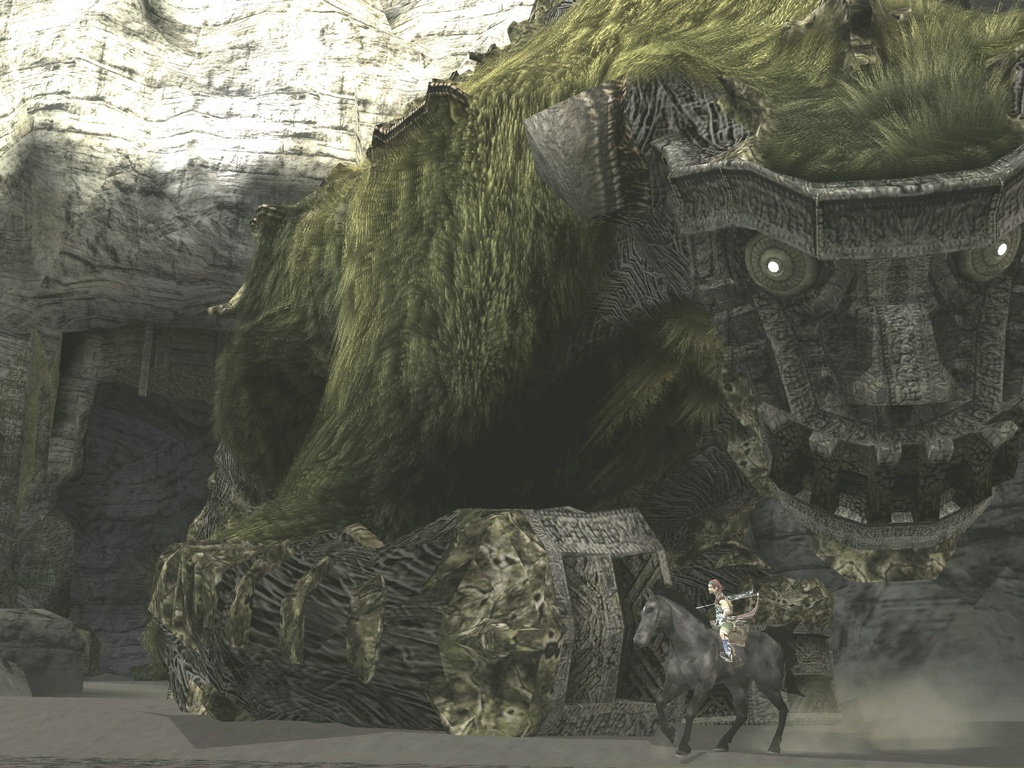
Lead designer Fumito Ueda and Team Ico explicitly aimed for a minimalist, lonely and whistful atmosphere for their games, ones that leave story to the side and focus on emotion. The upcoming Last Guardian, which centers around the relationship between a mountain boy and a gigantic dog/bird hybrid,seems to continue this trend.Fans of Ueda's games describe them as dreamy and engrossing, and I can say that, even from an outsider's perspective, I can feel the spell. While I've read some fantastic peices on these games, I don't want to get too much into the mindset of interpreting them before I've even begun. I'm looking forward mostly to the feeling. The more I look at screenshots and videos, the more I feel the desire to spend a month or so in some dusty tundra in an unnamed foreign land, cooped up in small shack with a howling wind and only these games to keep me company. They seem to demand to be played with minimal distraction. I'll leave you with these images. I feel they are more fitting for a group of games that seem more to want to leave an impression, a felt sense, than to entertain or excite the intellect.
As a bonus, check out the Japanese box art for the re-releases of Ico and Shadowvia VG247.com. Very cool. The Ico and Shadow of the Collosus Collection will be out in the United States on Playstation 3 September 27th. The Last Guardian is TBA 2012.
E3 2011 has come and gone, and with it a whirlwind of information on upcoming video games and consumer electronics, all of it filtered through the corporate mouthpeices of game companies, with snippets from the nerds whose work keeps them talking. The main focus of E3 is on huge commercial productions like Call of Duty 37, Halo 16, 3D Playstations and novelty consoles from Nintendo. Along with these chest-thumping endeavors, though, is the feeling of the new, the novel, the changing, The Future. Even for ideas and promises that won't see fruition or that will clearly bomb, E3 has a largesse for optimism, freely imbuing anyone who follows it with an excitement for what is to come. It is with this mind to seeing how gaming is changing and how it can be changed that I begin this list. I wanted to highlight a few games, some big, most small, that I'm most looking forward to.
Papo & Yo
In Braid, Jonathan Blow sought to create a game whose mechanics directly related to and deepened its themes. The game garnered heavy praise and I personally enjoyed it thoroughly; it was also one of the few that my girlfriend got hooked on. However, serious critics gave Blow a good deal of flack, claiming that it failed to properly achieve its aim, that the connection was lacking between thematics and gameplay. I tend to agree with them. The poetic level introductions set up a decently mature storyline and we were told, both in-game and through promotion, that the gameplay mechanism of time manipulation was meant to serve as a philosophical correlary to the story. Press square. Reverse character motion. Induce reflective moment. When I actually played the game though, it felt like a very clever platformer/puzzler with a beautiful aesthetic that was enhanced by the story set-up. The reflective part never really came into the equation for me.
In hearing about Minority Media’s first full game, the upcoming PSN download Papo & Yo, I’m wondering if we have a new shot at Blow’s dream, a game that does emotional depth through its gameplay. I’m guessing it won’t turn the gaming world on its head, but the possibility is still exciting. Despite its shortcomings, Braid was still a fantastic game head and shoulders above most, and if Papo & Yo feels even half as fresh, it’ll be worth the price of admission.
The game’s title is a thinly vield Spanportuglish mishmash that translates as Father and Me, a reference to creator Vaner Caballero’s experiences growing up with an alcoholic father in Colombia. The metaphorical stand-ins for father and son are a boy named Quico and his pet monster, Monster. I’m already endeared. The game’s adventures occur in Quico’s imagination as he attempts to escape the harshness of life in an unnamed South American favela. Monster tags along to help out on the puzzles and challenges that arise in Quico’s mind quest. Monster, however, is not as sweet as he seems at first: he is rabidly addicted to eating frogs and will sometimes act so impulsively in his pursuit of more frogs that he screws up Quico’s pursuits. I’m not much for summary (and I’m summarizing from what I’ve read anyway), so I’ll leave the rest of the description to a quote from IGN:
In his mind Quico can adventure in a surreal world where he can move houses simply by pushing around cardboard boxes, or where he can tug magical ropes to make stairs raise out of the ground. It's semi-realistic looking in its presentation, but mixes in enough strange scenery and bizarre looking environments that playing it is akin to moving through a waking dream. It's striking.
Video games tend to be an insular, thematically slight medium in which much of the meaning that is explicit often refers back to other games themselves (I’m still looking at you Braid). Whoever observed that there are more books written about other books than any other topic would have something to say about the nostalgia binge of the last five years. In this light, it’s exciting to hear about an atmospheric, thematically ambitious game that not only takes on the typical, if excellent, triumverant of nostalgia, coming of age and fantasy, but does so with a clear consciousness of weighter issues, namely global poverty and the harm it wreaks on families. I’m not going to get into the possibility of game published on Playstation Network potentially implying methods of resistence to the neo-liberal order (a guy can dream can’t he), but I’m already seeing monstrous potential for this game to mix fantasy, personal emotion and political reality in stunning ways (pun intended). All it needs to do is be touching though, and I’ll love it just the same.
Period setting with overt Americana imagery. Check. Meta-cosmic themes that imply the transcendence of suffering through gratitude. Check. Beautiful cinemetography. Check. Famed director (and actors) whose previous movies I've loved. Check.
Terrence Malick's Tree of Life is a movie that I should love. To list its elements is to describe exactly what I would want out of a movie, a dream project to anticipate with adolescent, fanboy suspense. I should leave the theater feeling invigorated, alive, yet reflective and perhaps bitersweet, ready to both take on the world and find acceptance in its failings, to Appreciate my own existence in such a way that adds a skip to my step and a bit more compassion to my heart. So after having seen Tree of Life last night, I'm left wondering, what went wrong? Why didn't I like this movie?
I'll begin with the ending. The last twenty minutes, after the close of the main plot line, show a seemingly endless parade of loosely connected mini-segments filled with lush beaches, deserts, skyscrapers and the same edge-lit trees that fill the rest of the film. Each shot is beautiful. Each shot is a bit confusing. At first, I probed around in corners of my mind, trying to make sense of it. "What does the beach symbolize? Why are his older self and his child self both there? Isn't that the guy from his hometown?" As three minutes extended into ten, I began to wonder if Mallick's "newest masterpiece" could go on forever, each fade-to-black followed by yet another image of some awe-inspiring landscape, another shot of Sean Penn seeming tired and nostalgiac, another nervous leaf again proclaiming the grandeur of existence. It was visually beautiful. It also felt like fluff. All I wanted was for it to end.
My problem with the ending mirrors my problem with the film as a whole: it is so thoroughly saturated with a sense of self-importance that it fails to realize the need to grab the audience and make them feel why it is so important. Twenty minutes in, during the dancing planets sequence, we hear a mother's heartfelt voice whisper over a shot of an ocean, "Light of my light" to her dead son. It could be powerful, but we've barely seen either of them yet, and so it feels like you're being sold on it. You are so beaten over the head with depth and importance, your attention made to focus so much on what a great film this is, that you can't properly think about the content of the film itself. Between the (admittidely gorgeous) visuals, the in-your-face opera score that plays over much of the film, and the constant snippets of voiceover, much of it spoken in whispers, it often feels like you're watching a 138-minute advertisement for the film, rather than watching the film itself. I'm reminded of an episode from season two of the Simpsons, where Smithers takes a job as the announcer at a greasy racetrack ("Get ready for Action! Action! Action!"). Feeling awkward at the constant enthusiasm required by the position, he complains, "The people are already here, we don't need to keep hustling them like this, do we?"
To be fair, Tree of Life does have a lot going for it. The performaces are amazing, as are the shots (nearly every single moment is gorgeous), and it does have some genuinely touching and disturbing moments. I expected these things. But I also expected to be drawn in, moved, made to think- about the subjects that the film is about: the universe, our place in it, the connection between the personal and universal, the unarticulable power of life. Instead, I felt like the film wanted me to think about how awesome the film was for being about those subjects.
I could be wrong though. And the next thing I'm doing is seeing it again.
Recent articles in Yahoo! News and The Chronicle of Higher Education detail new research by sociologists Richard Arum of New York University and Josipa Roksa of the University of Virginia that indicates that college students aren't learning much in their first two years, at least in terms of the criteria layed out by Arum and Roksa:
A study of more than 2,300 undergraduates found 45 percent of students show no significant improvement in the key measures of critical thinking, complex reasoning and writing by the end of their sophomore years.
What surprises me about this report is that critical thinking, complex reasoning and writing, skills that define a liberal arts education, were the three most highly valued aspects of education. I've been hearing so muchaboutthecrisisoftheliberalarts that I forgot that these were still valued elements at all, let alone the most highly prized elements of learning. Certainly, no ambitious parents are pressuring their children into majoring in English or philosophy, and colleges around the country are beginning to kill off majors like these as as they shrink in popularity and are deemed irrelevant. Why is it that the most valuable skills are those explicitly imparted by disciplines widely forecasted to disappear in the next decade or so?
The question raised by this contrast relates to what we consider a good education: is the key measure of academic success the ability to think complexly and critically? Is it the learning of a particular trade skill? Traditionally, the liberal arts have prepared students for a diversity of paths in "the real world" by developing students' critical and complex thought. However, more recently, specialized scientific knowledge has become prized by many highly paying careers. The question then stands, do we still need the population to be...well...thoughtful?
If we bypass those questions, however, and go along with Arum, Roksa and the whole traditional of liberal university education, then we have to question the way that college is structured in the United States. What is it about our universities that makes students so miserably unprepared in these three crucial areas? I would argue that a large part of our failure in the liberal arts is related to a devaluing of them in comparison to vocational and scientific education. At most colleges, students must take some sort of liberal arts "core curriculum," a set of classes designed to give students a general liberal arts education. However, there is often little choice in the classes taken, and many are taught by adjunct faculty who teach the same class over and over with little passion. Students, save for the few liberal arts majors (6% as of 2006) or other interested students, don't take them seriously because the classes are not only mandated, but also seen as non-essential to career success. These classes are necessary roadblocks on the road to other, unrelated goals. This is certainly not true of all students, but it is certainly the case at my university and, by all indications, nationwide.
The trend is also influenced by the growing percentage of the population going to college. In the 1800s when the Ivy League was establishing itself, colleges catered to a small number of elite, male students. As higher education becomes more widespread, more societally assumed, and the skills explicitly demanded by society more technical, college becomes more vocational. College is no longer the land of wide green lawns, young upper class males weekending at the polo grounds and leisurely hours with Keats and Byron. It is an economic necessity more commonly provided to students who are not only pursuing specific careers, but also being encouraged and pressured to pursue those careers.
Perhaps college students are faring poorly in these tests because they are being tested on their liberal arts prowess when their focus, and society's focus for them, is vocational. I imagine that the test results would look different if they were administered to history, English, classics, philosophy, sociology or Asian studies majors - any group of students whose educational focus emphasizes critical thought. And, in fact, the report finds, "students who...have heavier reading and writing loads do well." What is it that we are not emphasizing, teaching, or valuing that makes these skills ones that can be ignored?
The question I am left with is: should we change the thrust of our advice to young people, placing more emphasis on "critical thinking, complex reasoning, and writing" skills (essentially: urging them to become English majors) or should we change the factors we test for to more closely resemble what we encourage (skills that lead to career/financial success)? Or, is there some other option? Perhaps as a society we need a population capable of thinking critically, and our measurements of what is necessary in education should reflect this so that we needn't pit thinking critically and being successful against one another.